Prohibited and mandatory directions
One-way traffic
One-way traffic with no exceptions

This information sign means that traffic may only travel in one direction. There are no exceptions, so no traffic can approach from the opposite direction.

At the other end of the same road, you will see this prohibition sign: no entry for any driver.
One-way traffic, except for cyclists and speed pedelecs

A supplementary sign may indicate exceptions.
In this example, cyclists and speed pedelec riders may travel in both directions.
The letter P refers to speed pedelecs. The sign may also show an A, a B, or a combination of these letters. A refers to a class A moped, and B to a class B moped.

At the other end of the same road, there is also a supplementary sign. From that direction, cyclists and speed pedelec riders may continue, but cars may not.
End of one-way traffic

One-way traffic normally applies until the next junction, but it can also end earlier when you see this warning sign.
From this sign onwards, traffic is allowed in both directions again.
No entry for drivers in either direction
No entry with no exceptions

This prohibition sign means that no driver may pass the sign in either direction.
The same sign is placed at the other end of the road. Cyclists are not allowed to pass it either.
No entry, except for cyclists and speed pedelecs

A supplementary sign may indicate exceptions.
In this example, cyclists and speed pedelec riders may travel in both directions.
No entry, except for local traffic

A supplementary sign may also state ‘Except local traffic’. Sometimes it says ‘Except local access’, but both mean the same thing.
Local traffic includes:
- residents and their visitors
- delivery drivers, maintenance services and inspectors
- public transport, such as De Lijn or TEC
- priority vehicles
- cyclists and horse riders
Supplementary signs may also be combined.
No entry for drivers in this direction
No entry for motor vehicles with more than two wheels

This prohibition sign means that drivers of motor vehicles with more than two wheels may not pass the sign in this direction. This also includes motorcycles with a sidecar.
A car may therefore still approach from the opposite direction.
No entry for quad bikes

This prohibition sign means that drivers of quad bikes may not pass the sign in this direction.
A quad bike may therefore still approach from the opposite direction.
No entry for motorcycles

This prohibition sign means that motorcyclists may not pass the sign in this direction.
A motorcycle may therefore still approach from the opposite direction.
No entry for motor vehicles with more than two wheels and motorcycles


This prohibition sign means that motor vehicles with more than two wheels and motorcycles may not pass the sign in this direction.
Different pictograms may also be combined on the same sign.
If you see one of the signs above with a pictogram, the restriction only applies in your direction and does not necessarily apply in the opposite direction. If you see the same sign without a pictogram, it will normally be placed at both ends of the road, meaning that the restriction applies in both directions.
No entry based on maximum gross weight

This prohibition sign means that vehicles with a MGW of more than 3500 kg may not pass the sign.

Because a car has a MAW of no more than 3500 kg, it may pass this sign marked 3500 kg.
However, other weight limits may also be shown.
No entry depending on the load
Dangerous goods

This prohibition sign means that vehicles carrying dangerous goods may not pass the sign.
Flammable or explosive substances

This prohibition sign means that vehicles carrying flammable or explosive substances may not pass the sign.
Polluting substances

This prohibition sign means that vehicles carrying polluting substances may not pass the sign.
Turning prohibited
Turning prohibited with no exceptions

This prohibition sign means that no driver or rider may turn in the direction of the arrow.
In this example, turning left is prohibited. Cyclists are not allowed to turn left either.
Turning prohibited, except for cyclists and speed pedelecs

A supplementary sign may indicate exceptions.
In this example, cyclists and speed pedelec riders are allowed to turn left.
No U-turns

This prohibition sign means that no driver may make a U-turn from this sign up to and including the next junction.
Mandatory direction
Mandatory direction with no exceptions

This mandatory sign means that all drivers must follow the direction shown by the arrow.
In this example, you must turn right and may not turn left. The arrow may also point left, or show a combination of straight ahead with either left or right.
In practice, this sign has the same effect as a prohibition sign banning a left turn, as you saw earlier.

In this example, you must continue straight ahead or turn right.
Here too, the sign has the same effect as a prohibition sign banning a left turn.
Mandatory direction, except for cyclists and speed pedelecs

A supplementary sign may indicate exceptions.
In this example, cyclists and speed pedelec riders are allowed to turn left.
Mandatory direction around an obstruction

This mandatory sign placed on an obstruction means that you must pass the obstruction on the side indicated by the arrow.
Traffic islands

As a general rule, you must pass traffic islands on the right.
A mandatory sign may be used to make this clear, but in some cases you may instead be required to pass on the left.
Pass on either side

If you see this information sign, you may pass it on either the left or the right.
Road signs
You must know the type and meaning of each road sign, understand who it applies to and which part of the carriageway it applies to. You do not, of course, need to know the sign number.

Information sign F19
One-way road.

Prohibition sign C1
No entry for any driver in this direction.
Information sign F19
One-way road.

Supplementary sign
Cyclists and speed pedelec riders may travel in both directions. The pictograms may be adapted for other types of road users.
Prohibition sign C1
No entry for any driver in this direction.

Supplementary sign
The road sign above does not apply to cyclists or speed pedelec riders. The pictograms may be adapted for other types of road users.

Warning sign A39
Two-way traffic after a section of one-way carriageway.

Prohibition sign C3
No entry for any driver in either direction.
Prohibition sign C3
No entry for any driver in either direction.
Supplementary sign
Cyclists and speed pedelec riders may travel in both directions. The pictograms may be adapted for other types of road users.
Prohibition sign C3
No entry for any driver in either direction.

Supplementary sign
The road sign above does not apply to local traffic.

Prohibition sign C5
No entry for motor vehicles with more than two wheels or motorcycles with a sidecar.

Prohibition sign C6
No entry for quad bikes.
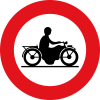
Prohibition sign C7
No entry for motorcycles.
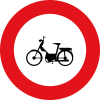
Prohibition sign C9
No entry for moped riders.

Prohibition sign C11
No entry for cyclists.
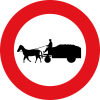
Prohibition sign C13
No entry for vehicles drawn by animals.

Prohibition sign C15
No entry for horse riders.
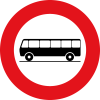
Prohibition sign C22
No entry for coaches.
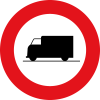
Prohibition sign C23
No entry for motor vehicles or combinations designed and built to carry goods.
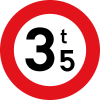
Prohibition sign C21
No entry for vehicles whose MGW exceeds the mass shown.
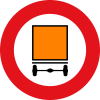
Prohibition sign C24a
No entry for vehicles carrying dangerous goods.

Prohibition sign C24b
No entry for vehicles carrying dangerous flammable or explosive substances.

Prohibition sign C24c
No entry for vehicles carrying dangerous substances that may pollute water.
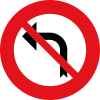
Prohibition sign C31a
No left turn at the next junction.

Prohibition sign C31b
No right turn at the next junction.

Prohibition sign C33
No U-turns from this sign up to and including the next junction.




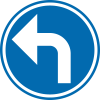

Mandatory sign D1
You must follow the direction shown by the arrow. The layout of the road determines the direction of the arrow. If the sign with a straight arrow is placed on an obstruction, you must pass the obstruction on the side indicated by the arrow.

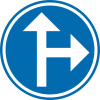
Mandatory sign D3
You must follow one of the directions shown by the arrows. The layout of the road determines the direction of the arrows.
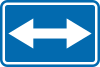
Information sign F21
You may pass on either the right or the left.
Ready to practise?
You’ve completed this section. Test your knowledge with 74 practice questions.
Start practice questions- PreviousPassing oncoming traffic and turning
- NextOvertaking