Priority in traffic
Turning and oncoming traffic

If you want to turn left and there is oncoming traffic, you must give way to the oncoming traffic.

This also applies if the oncoming vehicle wants to turn in the same direction as you: it still has priority.
A narrowing of the carriageway
A road narrowing without priority signs

A narrowing of the carriageway may be indicated by one of these warning signs.
If there are no additional priority signs, the driver whose side of the carriageway narrows must give way.
A road narrowing with priority signs

If priority signs are present, the driver who sees the blue sign has priority.

The oncoming driver sees the red circular sign and must give way.
Obstructions

If you have to move around an obstruction on your side of the carriageway, you must give way to oncoming traffic.
What is zip merging?
Sometimes, a lane ends or is blocked by an accident or roadworks. If these three conditions are met, you are required to zip merge (merge in turn):
- there are at least two lanes in the same direction of travel
- the number of lanes is reduced
- traffic is moving very slowly
This applies not only on motorways, but also on ordinary roads and even in built-up areas.

If there are two lanes and one of them ends, the driver in the ending lane goes first, followed by the driver in the other lane.

If two lanes end, drivers merge in turn in this order: first the right-hand lane, then the left-hand lane, and finally the middle lane.
Drivers in the ending lane must continue right up to the point where the lane narrows. You should therefore not merge earlier.
When joining a motorway, you never use zip merging.
A reduction in the number of lanes
A lane ending on the right

When a lane ends on the right, the driver in that lane has priority from the right.
Normally, a driver who changes lanes must give way, but in this specific situation, the courts have ruled that priority from the right applies.
Always take extra care when a lane ends on the right.
A lane ending on the left

When a lane ends on the left, the driver in that lane must give way.
Changing lanes is considered a manoeuvre in this situation, so the driver changing lanes must give way.
Remember: this has nothing to do with zip merging. In the examples above, two drivers reach the point where a lane ends at the same time, without there being a traffic jam or very slow-moving traffic.
Pedestrians

Pedestrians who are using a pedestrian crossing or are about to cross always have priority. Always approach a pedestrian crossing at a moderate speed.

When you turn, you must give way to pedestrians crossing the carriageway you are turning into.

A pedestrian crossing may be provided to make this clearer.

An additional information sign may also be used to draw your attention to a pedestrian crossing.

If you need to cross a footpath, you must also give way to pedestrians.
Cyclists

Cyclists and moped riders who are waiting to use a crossing do not have priority.

If they are already on the crossing, you must of course let them continue across. Always approach a crossing at a moderate speed.

When you turn, you must give way to pedestrians and other road users using other parts of the same public road.
In this example, the cyclist is riding on a cycle path that you need to cross, so you must give way to the cyclist.

An additional information sign may also be placed to make sure you do not miss this.

You must also give way to road users on a cycle path if you cross it while continuing straight ahead.
Road signs
You must know the type and meaning of each road sign, understand who it applies to and which part of the carriageway it applies to. You do not, of course, need to know the sign number.

Warning sign A7c
Carriageway narrows on the right.

Warning sign A7a
Carriageway narrows.

Warning sign A7b
Carriageway narrows on the left.
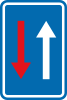
Priority sign B21
Narrow passage: you have priority over traffic coming from the opposite direction.
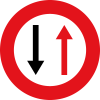
Priority sign B19
Narrow passage: you must give way to traffic coming from the opposite direction.


Information sign F97
Road sign indicating that the carriageway narrows by one lane.


Information sign F50bis
Information sign warning drivers who are turning that cyclists or two-wheeled moped riders are continuing along the same public road.
Ready to practise?
You’ve completed this section. Test your knowledge with 30 practice questions.
Start practice questions