Priority at junctions
Junctions where you have priority
Priority at the following junctions

This priority sign means that you are driving on a priority road and have priority at the junctions ahead.
The sign is repeated after each junction as a reminder.

The end of a priority road is indicated by this road sign.
Sometimes the sign is announced in advance, so you know that the priority road will end 150 metres further ahead.
Priority at the next junction

This priority sign means that you have priority at the next junction only.

The priority route does not always continue straight ahead. It may also bend to the left or right.
This is shown on the blue supplementary sign: the thicker curved line shows the priority route, while the shorter lines represent the side roads.
Junctions where you must give way
You must give way

This priority sign means that you must give way to other drivers.
If necessary, stop at the painted inverted triangles.
If you have a clear view and can see well in advance that no one else is approaching, you do not need to stop.

An additional supplementary sign may indicate that cyclists and moped riders can use the cycle path in both directions.

This priority sign may also be announced in advance, so you know that you will have to give way further ahead.
In this example, you know that you will have to give way 150 metres ahead.
You must stop and give way

This priority sign means that you must come to a complete stop and give way to other drivers.
You must stop completely at the stop line, even if you have a clear view.
If there is no stop line, stop at the sign.

An additional supplementary sign may indicate that cyclists and moped riders can use the cycle path in both directions.


This priority sign may also be announced in advance, so you know that you will have to stop and give way further ahead.
In this example, you know that you will have to stop 150 metres ahead.
The difference between the advance warning for ‘give way’ and ‘stop and give way’ is shown on the supplementary sign: it displays either only the distance, or ‘STOP’ followed by the distance.
Junctions with priority from the right
The general rule

If there are no priority signs or traffic lights, the priority-to-the-right rule applies. Every driver must give way to traffic approaching from the right.

Priority from the right may also be indicated by this priority sign, but the sign is not required.
Exceptions
A continuous cycle path

If a continuous cycle path runs across the junction, the road user on that cycle path does not have to give way to traffic from the right. In this example, the moped rider does not have to give way to the blue car.
Here, this is also indicated by road signs, but these are not required. The same priority rules apply even without the signs.
A driver travelling the wrong way

A driver who is travelling the wrong way loses priority from the right.
The red car is therefore committing an offence.

Remember that there may be exceptions to one-way traffic. You must give way to those road users if they approach from the right.
Rail vehicles do not follow the Highway Code

As you know, rail vehicles do not follow the Highway Code, so they do not have to give way to traffic from the right. The tram therefore has priority here.
A path or unsurfaced road

At a junction with a path or an unsurfaced road, you do not have to give way to traffic coming from the right.
A roundabout
Roundabouts and priority

You can recognise a roundabout by the blue informationn sign. On the approach roads, you will see either this priority sign or a STOP sign. This means that you must give way when entering the roundabout.
You may use your right indicator when entering the roundabout, but this is not compulsory. When leaving a roundabout, however, you must use your right indicator.
Roundabouts with multiple lanes

A roundabout may also have multiple lanes. This does not change the priority rules when entering or leaving the roundabout.
If you change lanes on the roundabout, you must always give way to other drivers.
Roundabouts with an adjacent cycle path

A roundabout may have a cycle path running alongside it. If you need to cross this cycle path when entering the roundabout, you must give way to its users.
The cyclist therefore goes first, and only then may you enter the roundabout. You may use your right indicator, but this is not compulsory.

The same rule applies when leaving a roundabout with a cycle path running alongside it: you must give way to road users on the cycle path.
When leaving a roundabout, you must use your right indicator.
Roundabouts with a cycle crossing set back from the roundabout

Sometimes a cycle crossing is located a short distance away from the roundabout.
As at any cycle crossing, cyclists do not have priority before entering it. Once they are already on the crossing, you must of course let them continue across.

The same rule applies when leaving a roundabout with a cycle crossing set back from it: cyclists must give way before entering the crossing.
When leaving a roundabout, you must use your right indicator.
A traffic island

Be careful: some junctions also have traffic islands. They may look a little like roundabouts, but they are not.
If there are no other priority signs, the priority-to-the-right rule applies.
Road signs
You must know the type and meaning of each road sign, understand who it applies to and which part of the carriageway it applies to. You do not, of course, need to know the sign number.

Priority sign B9
Priority road.

Priority sign B11
End of a priority road.

Priority sign B13
Advance warning of road sign B11 at approximately the distance shown.

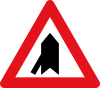
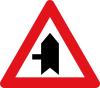
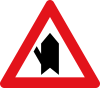
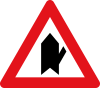


Priority sign B15
You have priority at the next junction.
Priority sign B15f
Priority at the next junction. The shape of the horizontal line may be adapted to show the layout of the junction more clearly.

Supplementary sign
Priority route.

Priority sign B1
Give way.
Priority sign B1
Give way.

Supplementary sign
Warning: cyclists and two-wheeled moped riders may approach from both directions.

Priority sign B3
Advance warning of road sign B1 at approximately the distance shown.

Priority sign B5
Stop and give way.
Priority sign B5
Stop and give way.
Supplementary sign
Warning: cyclists and two-wheeled moped riders may approach from both directions.
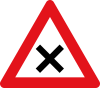
Priority sign B17
Priority from the right applies at the next junction.
Priority sign B17
Priority from the right applies at the next junction.
Supplementary sign
Warning: cyclists and two-wheeled moped riders may approach from both directions.

Information sign F19
One-way road.

Supplementary sign
Cyclists and speed pedelec riders may travel in both directions. The pictograms may be adapted for other types of road users.

Mandatory sign D5
Traffic must circulate in the direction shown.
Ready to practise?
You’ve completed this section. Test your knowledge with 81 practice questions.
Start practice questions- PreviousGeneral
- NextTraffic lights