Traffic lights
Traffic light colours
A red traffic light

When the red traffic light is on, you must stop at the stop line, or before the traffic light if there is no stop line.
An amber traffic light
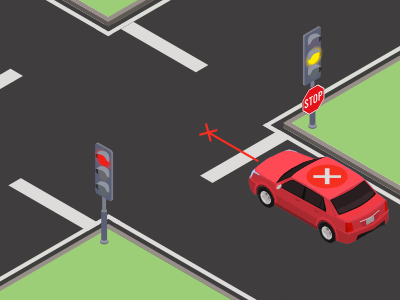
When the amber traffic light is on, you must also stop at the stop line. However, if you are so close to the stop line that you can no longer stop safely, you may continue through in this exceptional situation.
A green traffic light
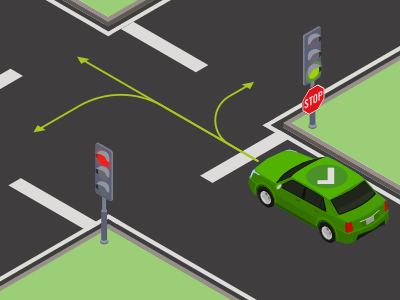
When the green traffic light is on, you may continue. You do not need to follow priority signs at that moment, such as the STOP sign in this example.

Be careful: only enter a junction if you can clear it completely. For example, if traffic is backed up, wait until there is enough space beyond the junction before moving off.
This applies to all junctions, including those without traffic lights.
Flashing traffic lights
The middle light is flashing

If the middle amber light is flashing, the traffic lights are not in operation and the priority signs apply. You therefore need to take extra care. The same applies if the traffic lights are completely switched off.
In this example, the green car is travelling on a priority road. The blue car must stop and give way.
The bottom light is flashing

If the green light has been replaced by a flashing amber light, you must also take extra care and follow the priority signs.
A separate light is flashing

If you see a separate flashing amber light, you must also take extra care.
In this example, pedestrians may cross even when you have a green light, so you need to watch out for them carefully. The light may also show a pedestrian or bicycle symbol.
Clearance arrow and green filter arrow
Clearance arrow

A clearance arrow is a green arrow pointing left, positioned on the far side of the junction. The arrow lights up when oncoming traffic has a red light. This tells you that you can turn left safely and clear the junction.
Drivers behind you also have a red light at this point and may no longer enter the junction.
If there is no oncoming traffic, you may of course turn left before the clearance arrow lights up.
Green filter arrow

A green filter arrow, also known as an advance arrow, is a green arrow shown together with a red light. When it is lit, you may proceed in the direction of the arrow, but you must still give way to other road users and pedestrians.
In this example, the pedestrians cross first, after which the blue car may turn right.
Traffic lights with arrows
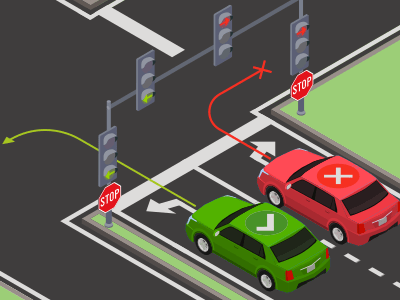
The three circular lights can also be replaced by three arrows. The meaning remains the same, but the signals then apply only in the directions shown by the arrows.
Position of traffic lights
Circular traffic lights
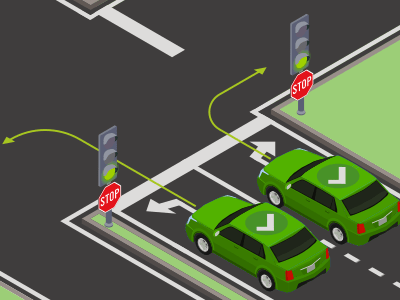
Circular traffic lights must always be positioned to your right.
They may also be repeated above the carriageway, to the left of the carriageway or even on the far side of the junction.
Arrow-shaped traffic lights
Three-colour arrow-shaped traffic lights may be positioned on the right or above the carriageway. If they are only positioned above the carriageway, they still apply.
They may also be repeated to the left of the carriageway or even on the far side of the junction.
Free-flow right-turn lane

If a traffic light is positioned only to your left, it does not apply to you.
You may therefore turn right using the free-flow right-turn lane. You must still give way to other road users.
Traffic lights for trams and buses
A horizontal bar

There are special traffic lights for trams and buses. They use bars, circles and triangles, shown in white on a black background.
A horizontal bar has the same meaning as a red traffic light: you must stop.
A circle
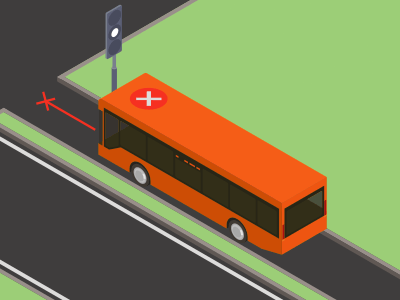
A circle has the same meaning as an amber traffic light: you must stop if you can still do so safely.
If the circle is flashing, it has the same meaning as a flashing amber light: the traffic lights are not operating normally.
An inverted triangle

An inverted triangle has the same meaning as a green traffic light.
A vertical bar
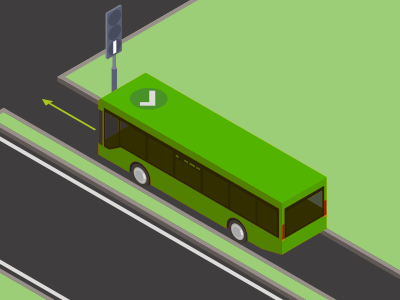
A vertical bar means that you may only continue straight ahead.
A diagonal bar
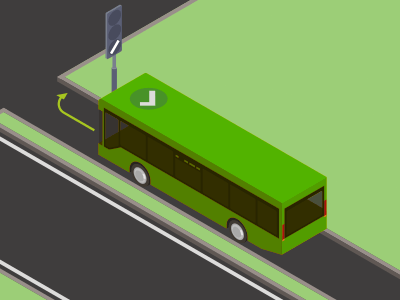
A diagonal bar pointing to the right means that you may only turn right.
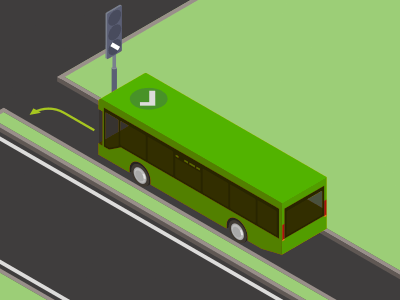
A diagonal bar pointing to the left means that you may only turn left.
You need to know what these traffic lights mean. For example, if you have to drive around a fixed obstruction and use the special reserved route to do so, you still need to understand the signals that apply there.
Cyclists and pedestrians
What is an advanced stop area for cyclists?

An advanced stop area for cyclists can be found at some junctions with traffic lights. When the traffic light is red, cyclists and riders of two-wheeled mopeds may use this area to wait at the front.
Other drivers must stop at the first stop line and may not use the advanced stop area.
Cyclists turning on red
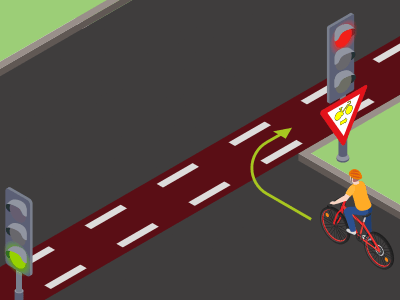
This road sign is for cyclists and speed pedelec riders. In this example, they may turn right even when the traffic light is amber or red. They must still give way to other road users.
The same symbol may also be shown in an additional flashing amber light positioned below the green light.
Cyclists and pedestrians have their own traffic lights with bicycle or pedestrian symbols. If you are driving a car, you do not have to follow these signals.
Road signs
You must know the type and meaning of each road sign, understand who it applies to and which part of the carriageway it applies to. You do not, of course, need to know the sign number.

Warning sign A33
Traffic lights ahead.
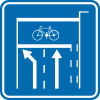
Information sign F14
Advanced stop area for cyclists and two-wheeled moped riders.

Priority sign B22
Cyclists and speed pedelec riders may pass a red or amber traffic light to turn right, provided they give way to other road users on the public road or carriageway.
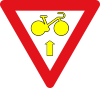
Priority sign B23
Cyclists and speed pedelec riders may pass a red or amber traffic light to continue straight ahead, provided they give way to other road users on the public road or carriageway.
Ready to practise?
You’ve completed this section. Test your knowledge with 41 practice questions.
Start practice questions- PreviousJunctions
- NextBus, tram and train