Built-up areas and speed limit zones
The built-up area
What is a built-up area?

A built-up area is an area where houses and other buildings are located close together. You can recognise the start of a built-up area by this road sign.
The name of the town or municipality is optional: the sign may also appear without a name.
How fast can you drive in a built-up area?
General rule
 In Flanders and Wallonia, the maximum speed limit in a built-up area is 50 km/h.
 In the Brussels-Capital Region, the maximum speed limit in a built-up area is 30 km/h.
Exception: a higher speed limit may apply in a built-up area

A different maximum speed limit may be imposed by an additional road sign placed at or after the start of the built-up area.
In this case, drivers may still travel at 70 km/h, up to and including the next junction, or until another road sign sets a new speed limit.

After the junction, this combination of road signs is often repeated to remind you that you are still in a built-up area and that from that point onwards, the maximum speed limit is 50 km/h again.
Exception: a lower speed limit applies throughout the built-up area

If a 30 km/h sign is placed above the sign marking the start of the built-up area, the maximum speed limit is 30 km/h throughout the entire built-up area, not just up to and including the next junction.
This only applies to a 30 km/h sign. It does not apply to other speed limits.
Pay close attention to which speed limit sign is combined with the sign marking the start of the built-up area, as the meaning can be different depending on the sign.
How fast can you drive outside a built-up area?

When you leave a built-up area, the maximum speed limit on ordinary roads is 70 km/h in Flanders and the Brussels-Capital Region, and 90 km/h in Wallonia.

When leaving a built-up area, road signs may also impose a different speed limit.
In this example, the maximum speed limit is 50 km/h up to and including the next junction.

If you come across a road sign like the one in this example before the next junction, you may once again drive at 70 km/h in Flanders and the Brussels-Capital Region, and 90 km/h in Wallonia.
Do not confuse it with a place-name sign

If you see a yellow sign with a red border, it is a place-name sign marking the boundary of a municipality.
This sign is not related to a built-up area and, by itself, has no effect on traffic rules.
Speed limit zones
What is a zone?

A zone is an area consisting of one or more roads. The maximum permitted speed is shown on the road sign.
This speed limit always applies, both during the day and at night.

A zone remains in force until you reach an ‘end of zone’ sign.
How fast may you drive in a zone?

The maximum permitted speed in a zone is shown on the road sign.
In this example, the maximum permitted speed is 50 km/h.
What is a variable speed limit zone?

An electronic zone sign may also be used. It is only in force when it is illuminated. The maximum speed may vary depending on the time of day or the day itself.
In this example, the current maximum permitted speed is 30 km/h.
Road signs
You must know the type and meaning of each road sign, understand who it applies to and which part of the carriageway it applies to. You do not, of course, need to know the sign number.
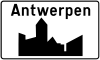

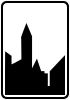
Information sign F1
Start of a built-up area.


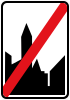
Information sign F3
End of a built-up area.

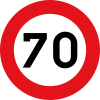

Prohibition sign C43
From this sign up to and including the next junction, you must not exceed the speed shown.

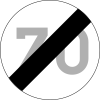
Prohibition sign C45
End of the speed limit imposed by road sign C43.

Prohibition sign C46
End of all local prohibitions applying to moving vehicles.
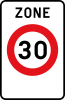
Information sign F4a
Start of a zone with a maximum speed of 30 km/h.
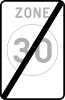
Information sign F4b
End of a zone with a maximum speed of 30 km/h.

Warning sign ZC43
Start of a zone with a maximum speed of 50 km/h.
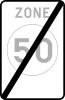
Warning sign ZC45
End of a zone with a maximum speed of 50 km/h.

Warning sign A31
Roadworks.

Information sign F47
End of roadworks.
Ready to practise?
You’ve completed this section. Test your knowledge with 65 practice questions.
Start practice questions- PreviousExpressway
- NextSpecial parts