Bus, tram and train
A bus stop
How do you recognise a bus stop?

A bus stop is indicated by a sign.

Road markings may also be used to make the bus stop more clearly visible.

Sometimes, a bus bay is also provided.
May you drive over a bus stop?

You may drive over a bus stop.
A bus lane
What is a bus lane?

A bus lane is not part of the carriageway. It is a special lane reserved for buses.
Sometimes, additional symbols are shown on the road sign or on a supplementary sign. These allow other road users, such as taxis, to use the bus lane as well.
May you drive in a bus lane?

You must not drive in a bus lane, except immediately before a junction when you need to turn.
You may also cross a bus lane at a junction, or when necessary to reach, for example, a shop or petrol station, or to drive around an obstruction on the carriageway.
A special reserved route
What is a special reserved route?

A special reserved route is not part of the carriageway. It is reserved for public transport, such as trams and buses.
Sometimes, additional symbols are shown on the road sign or on a supplementary sign. These allow other road users, such as taxis, to use the special reserved route as well.
May you drive on a special reserved route?

You must not drive on a special reserved route.
You may, however, cross a special reserved route at a junction, or when necessary to reach, for example, a shop or petrol station, or to drive around an obstruction on the carriageway.
At junctions, a chequered road marking is often used to show where you may cross it, but this marking is not compulsory.
A tram crossing

If you see this warning sign, it means that tram tracks cross the public road further ahead. Take extra care.
A level crossing
Road signs in advance of a level crossing

Level crossings can be divided into three groups: unprotected level crossings, protected level crossings with traffic lights only, and protected level crossings with both traffic lights and barriers.
If you see this warning sign, you are approaching a level crossing without barriers. It may still be protected by traffic lights, but in some cases it may be completely unprotected.
Unprotected level crossings are now quite rare, so you need to be particularly careful when approaching one.

If you see this warning sign, you are approaching a protected level crossing with both traffic lights and barriers.
If a level crossing is equipped with traffic lights but they are not working, you must approach it as if it were an unprotected level crossing.
Road signs at a level crossing

At the level crossing, you will see this cross-shaped road sign. It means that the level crossing has only one track.

If you see this road sign with an additional V above the cross, it indicates a level crossing with two or more tracks.
Road signs
You must know the type and meaning of each road sign, understand who it applies to and which part of the carriageway it applies to. You do not, of course, need to know the sign number.

Information sign F17
Carriageway with a lane reserved for buses.

Information sign F18
Special reserved route for vehicles providing regular public transport services.

Information sign F18
Special reserved route for vehicles providing regular public transport services.

Warning sign A49
Tram tracks crossing the public road.

Warning sign A43
Level crossing without barriers.
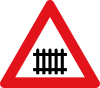
Warning sign A41
Level crossing with barriers.

Warning sign A45
Single-track level crossing.

Warning sign A47
Level crossing with two or more tracks.
Ready to practise?
You’ve completed this section. Test your knowledge with 34 practice questions.
Start practice questions- PreviousSpecial parts
- NextPractice questions