Cycle paths and footpaths
The cycle path
What is a cycle path?

A cycle path is the part of the public road reserved for cyclists and class A mopeds, who must use it. Riders of class B mopeds or speed pedelecs may also be allowed, or sometimes required, to use the cycle path.
Three- and four-wheeled vehicles that are no more than 1 metre wide are treated as bicycles, such as a cargo bike.
A cycle path may be located on either the right or the left side of the carriageway. It is sometimes coloured red, but this is not compulsory.
A cycle path is not part of the carriageway. You must therefore not drive on it with a car.
Even stopping on a cycle path to let someone get in or out is prohibited.
How do you recognise a cycle path?
A cycle path can be indicated by road markings

If you see two parallel broken lines with too little space for a car between them, this indicates a cycle path. In that case, no road sign is required.
A cycle path can be indicated by road signs

If you see this mandatory sign, it also indicates a cycle path.

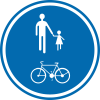
If you see this mandatory sign showing a cyclist next to a pedestrian, this area is intended for pedestrians, cyclists, speed pedelecs and class A mopeds.

If you see this mandatory sign showing a pedestrian above a cyclist, this area is intended for pedestrians and cyclists.

A supplementary sign may also be added to prohibit a certain type of moped or speed pedelec.

A supplementary sign may also be added to require a certain type of moped or speed pedelec to use it.
Crossing for cyclists and two-wheeled moped riders

A crossing for cyclists and two-wheeled moped riders is announced about 150 metres in advance by this warning sign.
If the distance is different, as in this example where it is 50 metres, this is shown on a supplementary sign.

At the crossing itself, you will see this information sign.
Cyclists and moped riders who want to cross may not simply ride onto the carriageway: they do not have priority. However, once they are on the crossing, you must let them pass. Therefore, always approach a crossing at a moderate speed, so that you do not endanger cyclists or moped riders who are crossing.
Also remember that in a traffic jam, you must always keep the crossing clear.
End of a cycle path

You saw earlier that this warning sign indicates a crossing for cyclists and two-wheeled mopeds. However, it can also be used to indicate the end of a cycle path.
In that case, the sign warns that cyclists or moped riders will leave the cycle path because it ends. They will therefore move onto the carriageway and have priority when doing so.
If cyclists or moped riders leave the cycle path for another reason, for example because of an obstruction, they do not have priority.
What is an advanced stop area for cyclists?

An advanced stop area for cyclists can be found at some junctions with traffic lights. When the traffic light is red, cyclists and riders of two-wheeled mopeds may use this area to wait at the front.
Other drivers must stop at the first stop line and may not use the advanced stop area.
What is a suggested cycle lane?

A suggested cycle lane is part of the carriageway and is marked in a distinctive colour, such as yellow, red, green, beige or another colour.
It is not a cycle path, so you must drive over it with your car. Stopping and parking are also allowed here.
Cycling in a group
Fewer than 15 cyclists?

If you are cycling in a group of fewer than 15 people, you follow the same rules as when cycling alone.
This means that you must use the cycle path if there is one.
At least 15 but no more than 50 cyclists?

If you are cycling in a group of at least 15 but no more than 50 people, you are no longer required to use the cycle path.
You may ride two abreast on the carriageway, but you must stay together as a group and may only use the right-hand lane. If there are no lanes, you may use no more than half of the carriageway.
Road captains and an escort vehicle are not compulsory, but they are allowed.
At least 51 but no more than 150 cyclists?

If you are cycling in a group of at least 51 but no more than 150 people, you are no longer required to use the cycle path.
You may ride two abreast on the carriageway, but you must stay together as a group and may only use the right-hand lane. If there are no lanes, you may use no more than half of the carriageway.
There must be at least two road captains, and the group must be accompanied by an escort vehicle at both the front and the rear.
Road captains

Road captains accompany the group and help keep everything running smoothly. At junctions without traffic lights, they may stop traffic so that the group can cross together.
The footpath or pavement
What is a footpath?

A footpath, also known as a pavement, is the part of the public road reserved for pedestrians.
The footpath is not part of the carriageway, so you may not drive a car on it.
Even being stationary on the footpath briefly to let someone get in or out is prohibited.
How do you recognise a footpath?
A footpath is always surfaced

A footpath may be raised, but it does not have to be. It is, however, always surfaced, and the boundary between the footpath and the other parts of the public road must be clearly visible, for example by using a different colour or material.
A footpath may also be indicated by road signs

If the boundary of the footpath is not clearly visible, this mandatory sign may be used. The area indicated by the sign is therefore also a footpath.
If you see this mandatory sign with a cyclist next to a pedestrian, this part of the road is intended for pedestrians, but also for cyclists, speed pedelec riders and class A moped riders.
If you see this mandatory sign with a pedestrian above a cyclist, this part of the road is intended for pedestrians and cyclists.
Pedestrian crossing

A pedestrian crossing, or zebra crossing, is announced about 150 metres in advance by this warning sign.
If the distance is different, this is shown on a supplementary sign.

At the crossing itself, you will see this information sign.
If there is a pedestrian crossing within 20 metres, pedestrians must use it. Pedestrians who are using a crossing or clearly intend to use it always have priority. You should therefore always approach a pedestrian crossing at a moderate speed.
Pedestrians crossing where there is no pedestrian crossing do not have priority, but you must still be careful. Also remember that in a traffic jam, you must always keep the crossing clear.
Winged zebra crossing

A winged zebra crossing is extended backwards against the direction of traffic. Instead of being 3 to 4 metres long, the crossing is extended to 8 or 9 metres.
This extension creates an extra buffer, making vehicles stop earlier and further back. Since vehicles are not allowed to be stationary on a zebra crossing, this gives you a better view of pedestrians crossing and helps improve safety.
May you cycle on the footpath?

If there is a usable cycle path, cyclists are required to use it.
Within a built-up area, you may not cycle on the footpath or raised verge. Outside a built-up area, you may do so if there is no usable cycle path and the footpath or raised verge is on the right-hand side in your direction of travel.
Children under 10 may always cycle on the footpath or raised verge.
Road signs
You must know the type and meaning of each road sign, understand who it applies to and which part of the carriageway it applies to. You do not, of course, need to know the sign number.

Mandatory sign D7
Mandatory cycle path.

Mandatory sign D9
Part of the public road reserved for pedestrians, cyclists and class A two-wheeled moped riders.
Mandatory sign D10
Part of the public road reserved for pedestrians and cyclists.

Warning sign A25
Crossing for cyclists and two-wheeled moped riders, or a place where they join the carriageway from a cycle path.

Information sign F50
Crossing for cyclists and two-wheeled moped riders.
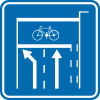
Information sign F14
Advanced stop area for cyclists and two-wheeled moped riders.
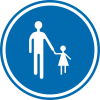
Mandatory sign D11
Mandatory footpath for pedestrians.

Warning sign A21
Pedestrian crossing.

Information sign F49
Pedestrian crossing.
Ready to practise?
You’ve completed this section. Test your knowledge with 49 practice questions.
Start practice questions