The expressway
What is an expressway?
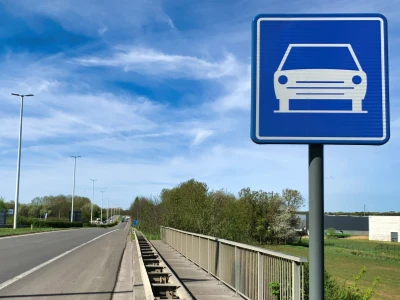
You can recognise an expressway by this blue road sign. Unlike a motorway, an expressway may have junctions and traffic lights.
Only motor vehicles may use an expressway, with the exception of:
- agricultural vehicles
- four-wheeled motor vehicles without a passenger compartment, such as quad bikes
- mopeds
- vehicles towing fairground trailers
An expressway may have several lanes, but it can also have only one lane in each direction.
It is prohibited to make a U-turn, reverse or drive against the direction of traffic.
How fast can you drive on an expressway?
The general rule on expressways
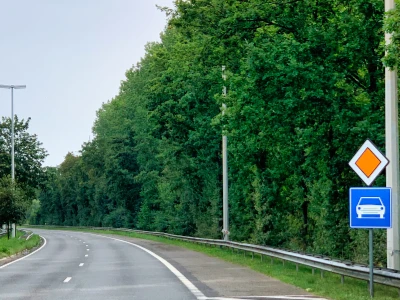
An expressway does not have its own specific maximum speed limit. The same speed limits apply as on ordinary roads.
It is a common misconception that the expressway sign itself determines the maximum speed limit. If you encounter the situations shown below without the expressway sign, the same maximum speed limits still apply.
If the road in the examples below runs through a built-up area or another speed zone, the maximum speed limit for that built-up area or speed zone applies.
At least two lanes in each direction and a central reservation, but no speed limit sign
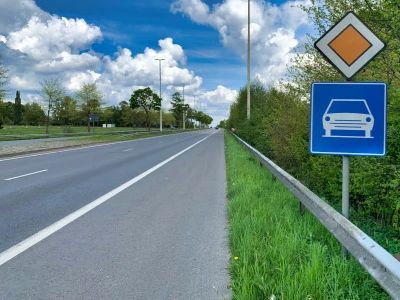
If there are at least two lanes in each direction, a central reservation, and no road signs imposing a lower speed limit, the maximum speed limit is 120 km/h.
At least two lanes in each direction and a central reservation, with a speed limit sign
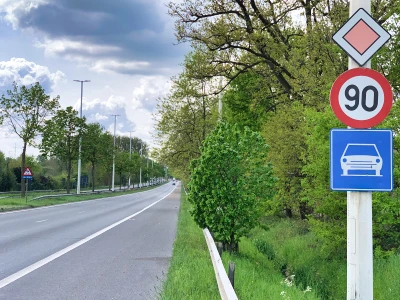
Even if there are at least two lanes in each direction and a central reservation, an additional road sign may impose a different maximum speed limit.
Beyond this sign, for example, you may drive at no more than 90 km/h.
At least two lanes in each direction, but no central reservation
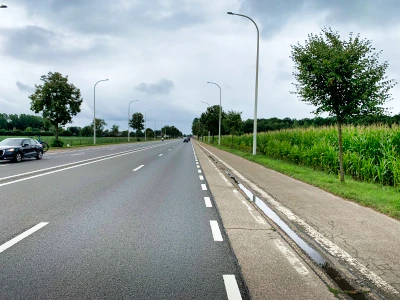
If there is no central reservation, the maximum speed limit is 70 km/h in Flanders and the Brussels-Capital Region, and 90 km/h in Wallonia.
Only one lane in each direction, but with a central reservation
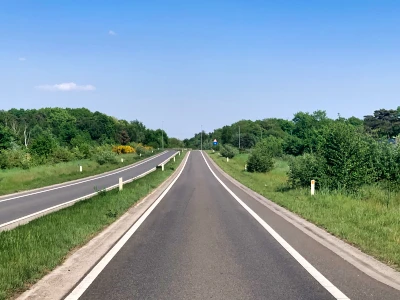
If there is only one lane in each direction, but there is a central reservation, the maximum speed limit is 70 km/h in Flanders and the Brussels-Capital Region, and 90 km/h in Wallonia.
Only one lane in each direction and no central reservation
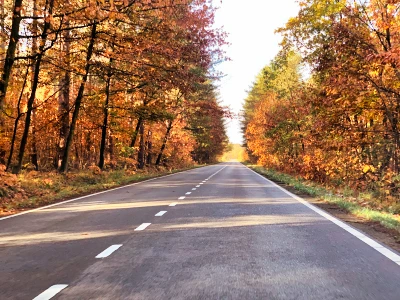
Even if there is no central reservation, the maximum speed limit is 70 km/h in Flanders and the Brussels-Capital Region, and 90 km/h in Wallonia.
What should you do if you break down?
Placing your warning triangle
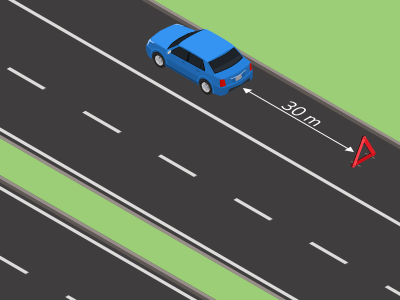
If you break down or have an accident, place your warning triangle as soon as possible, at least 30 metres behind your car.
It must be visible to approaching traffic from at least 50 metres away.
A high-visibility vest

If you get out of the car, you must wear a high-visibility vest, so you are required to have one with you. Passengers are not required to wear one, but it is strongly recommended for their safety.
For your own safety, always stand behind the crash barrier. Staying inside the car is extremely dangerous.
Can your car no longer be driven?
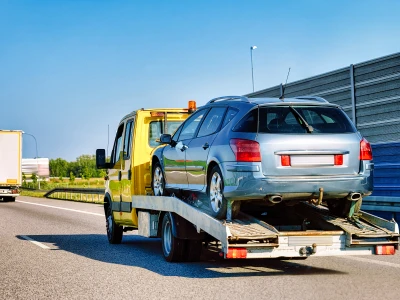
If your car can no longer be driven and you and your passengers are in a safe place, call 112 as soon as possible. They will arrange for a recovery vehicle to come to the scene.
It is not allowed to call a friend and try to tow the car yourself using an emergency or auxiliary coupling on the expressway.
What is an emergency corridor?
An emergency corridor provides a clear route for emergency services, allowing them to reach the scene more quickly. You must form an emergency corridor when:
- there are at least two lanes in the same direction of travel
- traffic is congested
This applies not only on motorways, but also on ordinary roads and even in built-up areas. It is important to form the emergency corridor before traffic comes to a complete standstill, even if no priority vehicle is approaching yet.

If there are two lanes, drivers in the left-hand lane move as far to the left as possible, while drivers in the right-hand lane move as far to the right as possible.

If there are more than two lanes, drivers in the left-hand lane move as far to the left as possible, while drivers in all other lanes move as far to the right as possible.
To form an emergency corridor, stay as much as possible within your own lane. In principle, you must not use the breakdown lane, bus lane, cycle path, and so on.
What is zip merging?
Sometimes, a lane ends or is blocked by an accident or roadworks. If these three conditions are met, you are required to zip merge (merge in turn):
- there are at least two lanes in the same direction of travel
- the number of lanes is reduced
- traffic is moving very slowly
This applies not only on motorways, but also on ordinary roads and even in built-up areas.

If there are two lanes and one of them ends, the driver in the ending lane goes first, followed by the driver in the other lane.

If two lanes end, drivers merge in turn in this order: first the right-hand lane, then the left-hand lane, and finally the middle lane.
Drivers in the ending lane must continue right up to the point where the lane narrows. You should therefore not merge earlier.
When joining a motorway, you never use zip merging.
Road signs
You must know the type and meaning of each road sign, understand who it applies to and which part of the carriageway it applies to. You do not, of course, need to know the sign number.
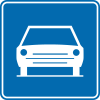
Information sign F9
Start of an expressway.
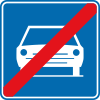
Information sign F11
End of an expressway.

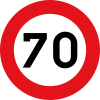

Prohibition sign C43
From this sign up to and including the next junction, you must not exceed the speed shown.
Prohibition sign C43
From this sign up to and including the next junction, you must not exceed the speed shown.

Supplementary sign
What the main sign indicates begins approximately 200 metres ahead.
Ready to practise?
You’ve completed this section. Test your knowledge with 44 practice questions.
Start practice questions- PreviousMotorway
- NextBuilt-up areas and speed limit zones