The public road explained
Definitions
What is a public road?

A public road is a road that is freely accessible to everyone. You do not have to explain why you want to use it.
What is a public area?

A public area is a place you only use when you have a reason to be there, such as a shop car park.
What is a non-public area?

A non-public area is a place you’re not allowed to enter freely: you need permission to be there. For example, this could be a restricted company site that is only accessible to suppliers.
What is a private road or private property?

A private road or private property belongs to a person or company and may only be used by certain people. It is therefore not a public road.
In exceptional cases, the owner may allow everyone to use the road, for example when it is a slow road. In that case, it is considered a public road.
The traffic regulations
Where do the traffic regulations apply?

The traffic regulations, or Highway Code, apply on public roads.
In principle, they do not apply to public or non-public areas, although courts have sometimes ruled differently in the past.
In any case, you can still receive a fine for an offence committed on either a public or a non-public area.
Who must follow the traffic regulations?

The traffic regulations apply to all road users: drivers, cyclists, pedestrians, and so on.
The only exception is rail vehicles using the public road, in other words, trams. They only have to obey traffic lights and orders given by an authorised person, such as a police officer.
What does a public road consist of?
Overview of the different parts

The public road consists of different parts, such as the carriageway, cycle path, verge, pavement, and so on.
Put simply, the public road extends up to where the residents’ front gardens begin.
The carriageway

The carriageway is the surfaced part of the road used by cars.
Cyclists and pedestrians may also use the carriageway in certain situations, for example when there is no cycle path or pavement.
A continuous white line may sometimes be marked along either side of the carriageway. This indicates the edge of the carriageway.

The carriageway can be divided into lanes using road markings.
There may be one lane in each direction, as in this example, or several lanes in each direction, for example on a motorway.

A wider continuous white line may also be marked. This indicates the notional edge of the carriageway.
The area to the right of this line is reserved for stopping and parking, except on motorways and expressways.
A path

A path is a narrow public road intended for pedestrians and for vehicles that take up no more space than pedestrians, such as bicycles.
An unpaved road

An unsurfaced road, also known as a dirt road, is a public road that is wider than a path but does not have a paved surface. It is also not intended for motor traffic.
In this example, the first few metres are surfaced, but it is still considered an unsurfaced road rather than a carriageway.
Road signs
You must know the type and meaning of each road sign, understand who it applies to and which part of the carriageway it applies to. You do not, of course, need to know the sign number.

Warning sign A1a
Dangerous bend to the left.
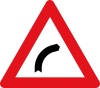
Warning sign A1b
Dangerous bend to the right.

Warning sign A1c
Two or more dangerous bends, the first to the left.
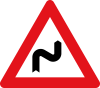
Warning sign A1d
Two or more dangerous bends, the first to the right.
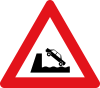
Warning sign A11
Quayside or river bank.

Warning sign A13
Dip or road hump.

Warning sign A15
Slippery road.

Supplementary sign
Risk of a slippery road due to ice or snow.

Warning sign A51
Other danger. A supplementary sign indicates the nature of the hazard.


Information sign F45
No through road.

Information sign F45b
No through road, except for pedestrians and cyclists.
Ready to practise?
You’ve completed this section. Test your knowledge with 31 practice questions.
Start practice questions- PreviousPublic road
- NextCycle paths and footpaths