Special parts of the public road
Elevated section
What is an elevated section?

An elevated section is built across the public road to make drivers slow down.
How is an elevated section indicated?

An elevated section is announced about 150 metres in advance by this warning sign.
If the distance is different, as in this example of 200 metres, it is shown on a supplementary sign.

Be careful: if the supplementary sign has upward-pointing arrows, this means that you will encounter several elevated sections over the distance shown.
In this example, the first elevated section is 150 metres ahead, and from there you may encounter several more over the next 200 metres.
How fast may you drive on an elevated section?

When an elevated section is indicated by these two road signs, the maximum permitted speed is 30 km/h.

If the elevated section is at a junction and is indicated only by this warning sign, the maximum permitted speed is also 30 km/h.
Central lane
What is a central lane?

A central lane is a central part of the carriageway intended for motorised traffic. You can recognise it by the parallel broken white lines, each consisting of two short dashes.
On either side there is a side strip. This is not part of the carriageway, so you may not normally drive on it with a car. You may, however, briefly use it when passing oncoming traffic or overtaking.
Cyclists, speed pedelecs and class A two-wheeled mopeds may use the side strip, as may animals in harness, pack or riding animals, and livestock.
How fast may you drive in a central lane?

The maximum permitted speed on a central lane is 70 km/h throughout Belgium, unless otherwise indicated.
This therefore also applies in the Brussels-Capital Region and in Wallonia.
Residential area
What is a residential area?

In a residential area, pedestrians may use the full width of the public road, and playing is also allowed.
Drivers must not obstruct or endanger pedestrians and must stop if necessary. They must take particular care around children, especially those who are playing.
How fast may you drive in a residential area?

The maximum permitted speed in a residential area or shared-space area is 20 km/h.
Cycle zone
What is a cycle zone?

A cycle zone is an area of public roads where cyclists, speed pedelecs and other cycles up to 1 metre wide are the main road users.
In a one-way street, they may use the full width of the carriageway. In other streets, they may use half of the carriageway.
Cars are allowed in a cycle zone, but they must not overtake cyclists, speed pedelecs or other cycles up to 1 metre wide.
A cycle zone may also be indicated by signs without the word ‘Fietszone’. Older signs displaying the words ‘Fietsstraat’ or ‘Zone fietsstraat’ are also still in use and have the same meaning.
How fast may you drive in a cycle zone?

The maximum permitted speed in a cycle zone is 30 km/h.
School area
What is a school area?

A school area is an area of public roads that includes the entrance to a school. It is indicated by the combination of these two road signs.
How fast may you drive in a school area?

The maximum permitted speed in a school area is 30 km/h.
School street
What is a school street?

A school street is a street near a school that is temporarily closed to motor vehicles, usually at the beginning and end of the school day.
The school street is reserved for pedestrians, cyclists and speed pedelecs. Cars are not allowed to enter, unless they have a permit.
How fast may you drive in a school street?

If you have a permit and are therefore allowed to drive in a school street, you must drive at walking pace.
You must also give way to pedestrians and cyclists, so that you do not obstruct or endanger them.
Play street
What is a play street?

A play street is a street that is temporarily closed to motor vehicles.
The entire width of the public road is then reserved for children playing. Cars are not allowed to enter, unless you live there, have a garage there, or have a permit.
Drivers must be especially careful around children who are playing: you must always give way to them and stop if necessary.
How fast may you drive in a play street?

If you are allowed to drive in a play street, you must do so at walking pace. You must give way to pedestrians, including those who are playing, so that you do not obstruct or endanger them.
Cyclists must dismount if necessary.
Pedestrian zone
What is a pedestrian zone?

In a pedestrian zone, pedestrians may use the full width of the public road, and playing is also allowed.
Cars may not enter the zone, unless your garage is located inside it and can only be reached by driving through the zone.
Parking is prohibited in a pedestrian zone.
How fast may you drive in a pedestrian zone?

If you are allowed to drive in a pedestrian zone, you must do so at walking pace. You must leave enough space for pedestrians and stop if necessary. You must not obstruct or endanger them.
If cyclists are allowed, they must also get off and walk if the area is too crowded.
Reserved road
What is a reserved road?

A reserved road is a road that may only be used by the road users shown on the road sign.
How fast may you drive on a reserved road?

If you are allowed to drive on a reserved road, the maximum speed is 30 km/h. In this example, that applies to a tractor, but other permitted vehicles, such as speed pedelecs, must also stay within this limit.
Tunnels
Before entering a tunnel

Switch on your dipped headlights before entering a tunnel. This makes you more visible to drivers behind you, prevents your lights from suddenly appearing much brighter and helps your eyes adjust to the darker conditions. You should also remove your sunglasses before entering.
Never reverse or make a U-turn in a tunnel.
How is a tunnel signposted?

A tunnel longer than 500 metres is indicated by this road sign. The name and exact length of the tunnel may also be shown on the sign itself or on a supplementary sign.
Low-emission zone
What is a low-emission zone?

A low-emission zone (LEZ) is an area where access for the most polluting vehicles is restricted in order to improve air quality. Each city decides for itself where to introduce such a zone.
The access requirements may differ from one zone to another. They depend, among other things, on the vehicle category, fuel type and Euro emission standard.
Road signs
You must know the type and meaning of each road sign, understand who it applies to and which part of the carriageway it applies to. You do not, of course, need to know the sign number.
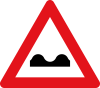
Warning sign A13
Dip or road hump.

Warning sign A14
Elevated section(s).

Warning sign A27
Wild animals crossing.
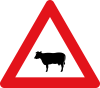
Warning sign A29
Cattle crossing.
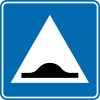
Information sign F87
Elevated section(s).
Warning sign A14
Elevated section(s).

Supplementary sign
What the main sign indicates begins approximately 200 metres ahead.
Warning sign A14
Elevated section(s).

Supplementary sign
What the main sign indicates begins approximately 150 metres ahead and continues for 200 metres.
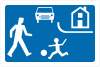
Information sign F12a
Start of a residential area or shared-space area.
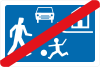
Information sign F12b
End of a residential area or shared-space area.


Information sign F111
Start of a cycle zone. The words ‘Cycle zone’ may be omitted from the sign.
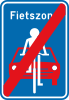

Information sign F113
End of a cycle zone. The words ‘Cycle zone’ may be omitted from the sign.

Warning sign A23
Children likely to be present.
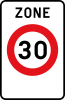
Information sign F4a
Start of a zone with a maximum speed of 30 km/h.

Prohibition sign C3
No entry for any driver in either direction.

Supplementary sign
School street.
Prohibition sign C3
No entry for any driver in either direction.

Supplementary sign
Play street.
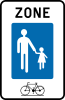
Information sign F103
Start of a pedestrian zone.
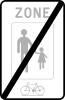
Information sign F105
End of a pedestrian zone.

Information sign F99a
Start of a reserved road or part of the public road for pedestrians, cyclists, horse riders and speed pedelec riders.

Information sign F101a
End of a reserved road or part of the public road for pedestrians, cyclists, horse riders and speed pedelec riders.
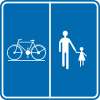
Information sign F99b
Start of a reserved road or part of the public road for pedestrians, cyclists, horse riders and speed pedelec riders, with separate areas indicated for the different types of road users.

Information sign F101b
End of a reserved road or part of the public road for pedestrians, cyclists, horse riders and speed pedelec riders, with separate areas indicated for the different types of road users.
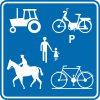
Information sign F99c
Start of a reserved road for agricultural vehicles, pedestrians, cyclists, horse riders and speed pedelec riders.

Information sign F101c
End of a reserved road for agricultural vehicles, pedestrians, cyclists, horse riders and speed pedelec riders.

Information sign F8
Tunnel more than 500 metres long.

Information sign F117
Start of a low-emission zone.

Information sign F118
End of a low-emission zone.
Ready to practise?
You’ve completed this section. Test your knowledge with 72 practice questions.
Start practice questions