An accident or breakdown
General rules in the event of an accident or breakdown
Safety first

An accident is always stressful, but try to stay calm and make the scene safe. This helps prevent further accidents.
Move the vehicles to the side of the road if it is still safe to do so. Also remove any debris from the road.
If the vehicles cannot be moved, switch on the hazard warning lights (if they still work) and place the warning triangle. Switch off the engines if this has not already been done, and make sure that no one smokes.
Where should you place the warning triangle?

The warning triangle must be visible to other road users from at least 50 metres away.
On motorways, place it at least 100 metres before the accident. On other roads, place it at least 30 metres away.
In a built-up area, you may place the warning triangle closer to the vehicle, or even on the vehicle itself, if there is no other practical option.
Pay attention to the difference between how far away you must place the warning triangle and the distance from which it must be visible.
Wear a high-visibility vest

If you get out of your vehicle on a motorway or expressway, you must wear a high-visibility vest. You are therefore required to have one with you.
On other roads, and for passengers, it is not compulsory, but it is strongly recommended for safety.
Stay at the scene - do not leave after an accident

If you cause an accident or are involved in one and drive away, you are committing a hit-and-run offence. This can result in severe penalties.
For example, if you hit a parked car and the owner is not present, contact the police immediately. If you fail to do so, this is also considered a hit-and-run offence.
An accident without injuries
Complete a European Accident Statement

If no one is injured, you do not need to call the police. Instead, complete a European Accident Statement together with the other people involved.
You complete the front of the form together and both sign it at the bottom. You can complete the back later on your own, as it is less important at the scene of the accident.
Everyone involved in the accident who is over 15 years old must show their identity card if another person involved asks to see it.
If you cannot agree on what happened, contact the police after all.
The other party is not present or cannot be identified

If you do not know who the other party is, for example because you have hit a bollard, contact the police. This will prevent you from committing a hit-and-run offence.
An accident with injuries
Call the emergency number

If anyone is injured, call 112. In that case, the police will always attend the scene.
Assess the situation as accurately as possible: are the injuries minor or serious, how many people are injured, is anyone trapped, and is there a fire or risk of fire? Stay calm and listen carefully to the operator’s questions.
Remember that someone with a nosebleed or a painful arm also counts as an injured person.
The injured

Speak calmly to the injured people to reassure them, helping them stay calm and conscious. If they are cold, you may cover them with a coat or blanket.
Leave injured people lying or sitting where they are. Only move them if there is an immediate danger, such as a fire.
Do not give them any food, drink or medication, including painkillers.
If the injured person is wearing a helmet, leave it on, unless there is no other option, for example if they are no longer breathing.
An accident or breakdown in a tunnel
Breakdown or minor damage

If you break down or have an accident in a tunnel, try, if possible, to drive out of the tunnel. This is often still possible with a flat tyre or if there is only minor damage.
If you cannot continue, switch on your hazard warning lights and stop as close to the tunnel wall as possible. Switch off the engine, but leave the key in the ignition.
Then leave your vehicle, preferably wearing a high-visibility vest, and contact the emergency services using the emergency telephone, which is indicated by this road sign. This allows the emergency services to identify your exact location immediately. The operator will then give you further instructions.
There is a fire or smoke

If your own car is on fire, try, if possible, to drive out of the tunnel. If you cannot, switch on your hazard warning lights and stop as close to the tunnel wall as possible.
If another vehicle is on fire, keep your distance and switch on your hazard warning lights. Never reverse and never turn around.
Switch off the engine, but leave the key in the ignition. Then leave your vehicle, preferably wearing a high-visibility vest, and contact the emergency services using the emergency telephone.
Get yourself and your passengers to safety using the emergency exits and continue until you reach the assembly point outside.
An escape lane

If your brakes are no longer working properly while driving in a hilly area, you may come across an escape lane, also known as a runaway track.
It is a separate lane that slopes gently uphill and usually ends in a large gravel bed.
By driving into the gravel bed, you can bring your vehicle to a safe stop, usually without causing any damage.
May you tow a vehicle?

On motorways and expressways, you are not allowed to tow a vehicle yourself using an emergency or auxiliary coupling.
On other roads, towing is allowed, but you must not exceed 25 km/h and you must drive directly to the place of repair.
What is an emergency corridor?
An emergency corridor provides a clear route for emergency services, allowing them to reach the scene more quickly. You must form an emergency corridor when:
- there are at least two lanes in the same direction of travel
- traffic is congested
This applies not only on motorways, but also on ordinary roads and even in built-up areas. It is important to form the emergency corridor before traffic comes to a complete standstill, even if no priority vehicle is approaching yet.

If there are two lanes, drivers in the left-hand lane move as far to the left as possible, while drivers in the right-hand lane move as far to the right as possible.

If there are more than two lanes, drivers in the left-hand lane move as far to the left as possible, while drivers in all other lanes move as far to the right as possible.
To form an emergency corridor, stay as much as possible within your own lane. In principle, you must not use the breakdown lane, bus lane, cycle path, and so on.
Road signs
You must know the type and meaning of each road sign, understand who it applies to and which part of the carriageway it applies to. You do not, of course, need to know the sign number.

Information sign F8
Tunnel more than 500 metres long.

Information sign F62
Emergency telephone.
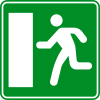
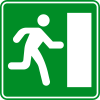
Information sign F52
Emergency exit in a tunnel.


Information sign F52bis
Direction of the nearest emergency exit in a tunnel. The distance in metres is shown on the sign.
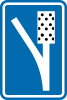
Information sign F95
Escape lane.
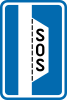
Information sign F98
Emergency refuge area.
Ready to practise?
You’ve completed this section. Test your knowledge with 48 practice questions.
Start practice questions- PreviousAuthorised persons
- NextPractice questions