Road signs
Parking permitted
The general road sign

From this road sign onwards, you may park on that side of the road. This applies until the next junction.
A specific vehicle type

A vehicle may also be shown on the road sign. In that case, only that type of vehicle may park there, on that side of the road. This applies until the next junction.
In this case, cars, motorcycles and minibuses may park there.

If a different type of vehicle is shown, such as a bus, lorry, motorhome or motorcycle, you may not park your car there.
Time-dependent parking

Time-dependent parking applies here. Between 07:30 and 18:00, only bicycles may park here. Between 18:00 and 07:30, the parking space is reserved for cars, motorcycles and minibuses. This applies until the next junction.
In this example, it is 19:00, so you may park your car here.
The vehicle types and times may vary from one road sign to another.
Parking with a parking disc

Here, you may only park for a limited time and must use a parking disc. The parking-disc symbol may also be shown on a supplementary sign. This applies until the next junction.
Unless indicated otherwise locally, this applies from Monday to Saturday, between 09:00 and 18:00, and you may park for a maximum of two hours.
When you arrive, set the parking disc to the first mark after the current time and place it clearly visible behind the windscreen.

A zone may also be indicated in which you must use a parking disc. This rule then applies until you reach an ‘end of zone’ sign.
Paid parking

Paid parking applies here. If the parking meter is out of order, you must use a parking disc. This applies until the next junction.

A zone may also be indicated in which you must pay to park. This rule then applies until you reach an ‘end of zone’ sign.
Parking on the verge, or not

Here, you must park on the carriageway. Parking on the verge is prohibited. This applies until the next junction.

Here, you must park partly on the carriageway and partly on the verge or footpath. This applies until the next junction.

Here, you must park on the verge or footpath. Parking on the carriageway is prohibited. This applies until the next junction.
Supplementary signs with arrows

Supplementary signs with arrows show more precisely where a road sign applies. In this example, the sign requires the use of a parking disc, but arrows can be combined with any parking sign.
An upward arrow marks the beginning of the area: from that road sign onwards, you must use a parking disc.

A supplementary sign with a double arrow repeats the area in which the rule applies.
It is placed between the sign with the upward arrow and the sign with the downward arrow.

The area ends at the supplementary sign with a downward arrow.
Before the road sign, you could only park using a parking disc. After the sign, you may park again without using a parking disc.

An upward arrow can also be combined with a stated distance. In this example, the parking disc is only required for 20 metres beyond the road sign.
In this example, the road sign requires the use of a parking disc. However, arrows can be combined with any parking sign.
A sign applying to a single parking space

If a road sign applies to an individual parking space, it only applies to that space.
In this example, the parking space is reserved for people with disabilities. You may only park here if you have a valid parking card for people with disabilities.

In this example, the parking space is reserved for electric or plug-in hybrid vehicles that are plugged in for charging.
Stationary or parked vehicles prohibited
Parking prohibited

From this road sign onwards, your vehicle must not be parked on the carriageway or verge on that side of the road. This applies until the next junction.
Stationary and parked vehicles are prohibited

From this road sign onwards, your vehicle must not be stationary or parked on the carriageway or verge on that side of the road. This applies until the next junction.
Tip: the road sign with one diagonal line imposes one prohibition: parking. The road sign with two diagonal lines, forming a cross, imposes two prohibitions: being stationary or parked.
Alternate-side parking

From this road sign onwards, your vehicle must not be parked on the carriageway on that side of the road from the 1st up to and including the 15th of the month. This applies until the next junction.

From this road sign onwards, your vehicle must not be parked on the carriageway on that side of the road from the 16th until the end of the month. This applies until the next junction.
Note that this prohibition only applies to the carriageway, not to the verge. You must change sides on the last day of the period, between 19:30 and 20:00.
Half-monthly alternate-side-parking

If this road sign is placed above the built-up area sign, half-monthly alternate-side parking applies throughout the entire built-up area.
From the 1st to the 15th of the month, you may park on the side with odd-numbered houses. From the 16th until the end of the month, you may park on the side with even-numbered houses.
Note that this prohibition only applies to the carriageway, not to the verge. You must change sides on the last day of the period, between 19:30 and 20:00.
Nowadays, you will rarely come across this sign.
Supplementary signs with arrows

Supplementary signs with arrows show more precisely where a restriction applies.
An upward arrow marks the beginning of the restriction: from that road sign onwards, your vehicle must not be stationary or parked on the carriageway or verge on that side of the road.

A supplementary sign with a double arrow repeats the restriction.
It is placed between the sign with the upward arrow and the sign with the downward arrow: your vehicle must therefore not be stationary or parked on the carriageway or verge on that side of the road, both before and after the sign.

The restriction ends at the supplementary sign with a downward arrow.
Your vehicle must therefore not be stationary or parked on the carriageway or verge on that side of the road before that sign.

An upward arrow can also be combined with a stated distance. In this example, the restriction applies for 20 metres from the sign onwards.
Road signs
You must know the type and meaning of each road sign, understand who it applies to and which part of the carriageway it applies to. You do not, of course, need to know the sign number.

Stationary and parked E9a
Parking permitted.

Stationary and parked E9b
Parking reserved for motorcycles, cars, dual-purpose vehicles and minibuses.

Stationary and parked E9c
Parking reserved for light goods vehicles and lorries.

Stationary and parked E9d
Parking reserved for coaches.

Stationary and parked E9h
Parking reserved for motorhomes.

Stationary and parked E9i
Parking reserved for motorcycles.

Stationary and parked E9j
Parking reserved for bicycles from 07:30 to 18:00 and for motorcycles, cars, dual-purpose vehicles and minibuses from 18:00 to 07:30. The symbols and times may be changed or shown on a supplementary sign.

Stationary and parked E9a
Parking is time-limited and a parking disc is required.

Stationary and parked E9a
Zone where a parking disc is required.

Stationary and parked E9a
End of a zone where a parking disc is required.
Stationary and parked E9a
Parking permitted.

Supplementary sign
Paid parking.

Stationary and parked E9b
Start of a paid parking zone.
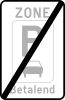
Stationary and parked E9b
End of a paid parking zone.

Stationary and parked E9g
Vehicles must be parked on the carriageway.

Stationary and parked E9f
Vehicles must be parked partly on the verge or footpath.

Stationary and parked E9e
Vehicles must be parked on the verge or footpath.

Stationary and parked E9a
Parking reserved for vehicles used by people with disabilities.

Stationary and parked E9a
Parking reserved for electric or plug-in hybrid vehicles that are connected for charging.

Stationary and parked E1
Parking prohibited.

Stationary and parked E3
Stationary and parked vehicles prohibited.

Stationary and parked E5
Parking prohibited from the 1st to the 15th of the month.

Stationary and parked E7
Parking prohibited from the 16th to the end of the month.
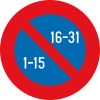
Stationary and parked E11
Half-monthly alternate-side parking throughout the built-up area.
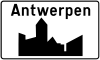


Information sign F1
Start of a built-up area.
Ready to practise?
You’ve completed this section. Test your knowledge with 106 practice questions.
Start practice questions- PreviousParking prohibited
- NextPractice questions