Third-degree offences
Here, we give you an overview of third-degree offences, but you do not need to memorise which offences fall into this category.
Remember: a third-degree offence costs you 5 points on the theory test.

You must always obey a police officer’s instructions immediately, for example by stopping when instructed to do so.
If your vehicle is stationary or parked, you must also move it immediately if a police officer tells you to.

You must be fit enough to drive safely and have the necessary knowledge and driving skills.
You must always be able to carry out all necessary actions and remain in full control of your vehicle or animals.

You may not use, hold or operate a mobile phone or other device with a screen while driving. You may only use such a device if it is secured in a holder inside the vehicle.

On a road with two carriageways separated by a central reservation, you may not drive on the left-hand carriageway, unless local traffic rules allow it.

You may not drive on the breakdown lane.

You must pass oncoming traffic on the right.

If you have to move around an obstruction on your side of the carriageway, you must give way to oncoming traffic.

If you use the verge that is level with the carriageway when passing oncoming traffic or overtaking because the carriageway is too narrow, you must not endanger other road users.

When passing an oncoming rail vehicle on the left, you must not obstruct or endanger oncoming traffic.

If you are being overtaken, you must keep as far to the right as possible and must not accelerate.

You may not overtake if you cannot see oncoming traffic clearly.
This may be the case in fog, heavy rain or other conditions with poor visibility.

You may not overtake at a level crossing without barriers or traffic lights.

You may not overtake a vehicle that is already overtaking another vehicle.

If the vehicle ahead stops at a pedestrian or cycle crossing, you may not overtake it.

Before moving into position to turn, first check that no one is overtaking you. You must also make sure that you do not obstruct oncoming traffic.

When turning left, you must give way to oncoming traffic.

When you turn, you must give way to road users on other parts of the same road, such as cyclists on a cycle path.

When you turn, you must give way to pedestrians crossing the carriageway you are turning into.

In a residential area or shared-space area, you must not obstruct or endanger pedestrians. Take particular care around children.

On a reserved road, you must not obstruct or endanger other road users. Take particular care around children and avoid holding up traffic unnecessarily.

If you are allowed to drive in a pedestrian zone, you must do so at walking pace. You must not obstruct or endanger pedestrians.

If you are allowed to drive in a play street, you must do so at walking pace. You must not obstruct or endanger pedestrians, and you should take particular care around children.

When it gets dark or visibility is reduced to less than 200 metres, you must use your dipped headlights.

Children under 18 and shorter than 1,35 metres may only be carried in an approved and correctly fitted child restraint system, except when they are being carried occasionally by someone other than their parents.
You must also not carry more children than there are seats fitted with a seat belt or child restraint system.

When a priority vehicle approaches, you must make way immediately, give it priority and stop if necessary.

When you see a school bus, take extra care. Stop if necessary, especially when both indicators are flashing to show that children are about to get on or off.

You must never endanger pedestrians.

When passing a bus or tram that has stopped to let passengers get on or off, you must slow down.

If there is no refuge island at a stop and passengers are getting on or off on your side of the road, you must give way to them. This means stopping so they can cross safely.

Pedestrians who started crossing while their light was green must be allowed to finish crossing, even if your own light has turned green in the meantime.
You must also never stop on the crossing.

Pedestrians who are using a pedestrian crossing or are about to cross always have priority. Always approach a pedestrian crossing at a moderate speed.

You must not drive through a group or split it up.
This may be a group of pedestrians, such as children, schoolchildren, older people or people with disabilities.
You must also not interrupt a procession or military column.
Nor may you interrupt a group of cyclists taking part in a race. When approaching such a group, you must move aside immediately and stop.

You must always follow the instructions of an authorised crossing supervisor who is helping people cross the road.
You must also follow instructions given by military personnel accompanying a column, road captains accompanying groups of cyclists or motorcyclists, group leaders accompanying pedestrians or horse riders, and supervisors at road works on the public road.

You must not endanger cyclists or moped riders and must take particular care around children and older people.
Keep at least 1 metre of lateral distance within a built-up area and at least 1,5 metres outside a built-up area.

Cyclists and moped riders who are about to use a crossing do not have priority.
Once they are already on the crossing, however, you must not obstruct or endanger them. Always approach a crossing at a moderate speed.

You must not pass a red traffic light.

Even when a green filter arrow (advance arrow) is lit, you must still give way to other road users.

You must not drive in a lane when a red cross is displayed above it.

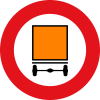


When carrying dangerous goods, you may not use certain roads.

You must never drive the wrong way.

You must always take the vehicle’s MGW into account, as some roads may be off-limits depending on its weight.

You must never ignore an overtaking prohibition.

You must not cross a continuous line or drive to the left of it when it separates traffic travelling in opposite directions.
You must also not cross a continuous yellow line.
Section completed!
The material from this section is also tested in the other exercises and practice tests.
- PreviousAlcohol and drugs
- NextFourth degree