Loading your car
Maximum authorised weight
What is the maximum authorised weight?

The maximum authorised weight, abbreviated as MAW, is the maximum total weight a car is allowed to have. This includes the driver, passengers, the full load and all fluids, such as fuel.
The MAW varies from one car to another, as it is determined by the manufacturer. Loading your car beyond this weight is prohibited.
With a category B driving licence (provisional or full), you may drive vehicles with an MAW of no more than 3500 kg.
Which road signs relate to the maximum authorised weight?
These road signs relate to the maximum authorised weight (MAW). At the bottom of this lesson, you can read exactly what each sign means, but they are also covered in detail in later lessons.
You can easily remember this using the word TOPS: signs about Trucks, Overtaking, Parking or Speed relate to the MAW.
Maximum gross weight
What is the maximum gross weight?

The maximum gross weight, abbreviated as MGW, is the actual weight of a car at a given moment.
Let’s take an average family car as an example. It weighs 1400 kg when empty and has an MAW of 1900 kg.
| Total, MGW | 1.500 kg |
| Car | 1.400 kg |
| Driver | 80 kg |
| Load | 20 kg |
The MGW must never exceed the MAW. In this example, the car weighs 1500 kg and its MAW is 1900 kg, so it is within the permitted limit.
Which road signs relate to the maximum gross weight?
This road sign refers to the maximum gross weight (MGW).
The following road sign also often relates to MGW, but after turning, you may encounter a road sign referring either to MAW or to MGW.
So when you see this combination, you will only know for certain after turning whether it referred to the MAW or the MGW.
May you tow a trailer?

With a provisional category B driving licence, you may not tow a trailer.
With a full category B driving licence, you may tow a trailer, provided that its MAW does not exceed 750 kg.

However, there is also an exception to the rule above.
For example, if your trailer has an MAW of 900 kg, you may still tow it with a full category B driving licence, provided that the combined MAW of the car and trailer does not exceed 3500 kg.
Vehicle dimensions
How high may your vehicle be?

If you are carrying something on the roof of your vehicle, the total height may not exceed 4 metres. Anything higher is considered abnormal transport.

Sometimes, bridges or tunnels are lower than usual and you will see this road sign. It means that you may not continue if your vehicle is higher than the height shown on the sign.
How wide may your vehicle be?

Your vehicle may be no more than 2,55 metres wide. Anything wider is considered an abnormal load.

Sometimes, the road is narrower than usual and you will see this road sign. It means that you may not continue if your vehicle is wider than the width shown on the sign.
May your load extend beyond the front or rear of your vehicle?

If you need to carry a long object, such as a ladder, it must never extend beyond the front of the vehicle. At the rear, it may extend by no more than 1 metre.

If your load is even longer and cannot be shortened, for example by taking it apart, it may extend up to 3 metres beyond the rear of the vehicle. As soon as the load extends by more than 1 metre, it must be clearly marked.
When the vehicle’s lights do not need to be used, a square panel with red and white stripes is sufficient. When lighting is required, you must also fit a red light facing backwards and an orange reflector on each side.

Sometimes, you will see this road sign. It means that you may not continue if your vehicle, including its load, is longer than the length shown on the sign.
Even though the sign shows a lorry, the rule applies to all vehicles and vehicle combinations.
Road signs
You must know the type and meaning of each road sign, understand who it applies to and which part of the carriageway it applies to. You do not, of course, need to know the sign number.
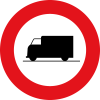
Prohibition sign C23
No entry for motor vehicles or combinations designed and built to carry goods.

Supplementary sign
The road sign above applies only to vehicles with a MAW of more than 3,5 tonnes.

Prohibition sign C39
From this sign up to and including the next junction, drivers of vehicles or combinations used to carry goods with a MAW of more than 3,5 tonnes may not overtake animals in harness or vehicles with more than two wheels on the left.
Supplementary sign
The road sign above applies only to vehicles with a MAW of more than 3,5 tonnes.

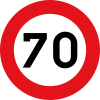

Prohibition sign C43
From this sign up to and including the next junction, you must not exceed the speed shown.
Supplementary sign
The road sign above applies only to vehicles with a MAW of more than 3,5 tonnes.

Stationary and parked E9a
Parking permitted.
Supplementary sign
The road sign above applies only to vehicles with a MAW of more than 3,5 tonnes.

Stationary and parked E1
Parking prohibited.
Supplementary sign
The road sign above applies only to vehicles with a MAW of more than 3,5 tonnes.

Stationary and parked E3
Stationary and parked vehicles prohibited.
Supplementary sign
The road sign above applies only to vehicles with a MAW of more than 3,5 tonnes.
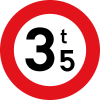
Prohibition sign C21
No entry for vehicles whose MGW exceeds the mass shown.
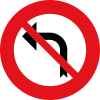
Prohibition sign C31a
No left turn at the next junction.

Prohibition sign C31b
No right turn at the next junction.

Prohibition sign C27
No entry for vehicles whose width, including the load, exceeds the width shown.
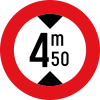
Prohibition sign C29
No entry for vehicles whose height, including the load, exceeds the height shown.

Prohibition sign C25
No entry for vehicles or combinations whose length, including the load, exceeds the length shown.
Ready to practise?
You’ve completed this section. Test your knowledge with 46 practice questions.
Start practice questions